Molecular competition induced Janus hydrogel bioelectronic interface for electroceutical modulation
摘要
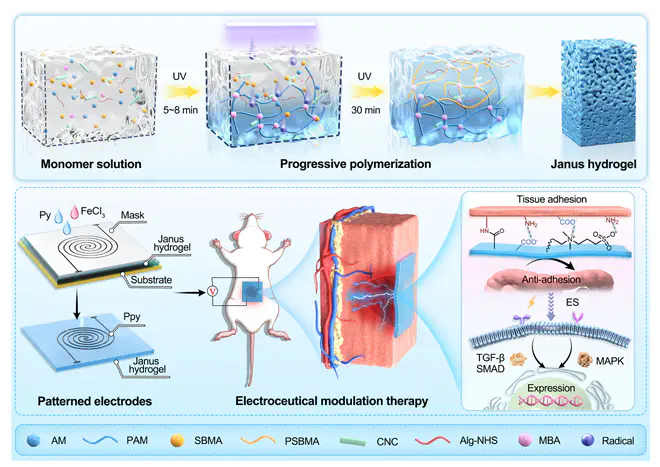
Janus hydrogel bioelectronic interfaces have long been challenged by complex fabrication procedures, poor controllability of asymmetric properties and weak interlayer bonding strength. Herein, we fabricated a Janus hydrogel with dual structural and compositional gradients in one step via Molecular Competition Induction mechanism. Unilateral UV light-driven competitive reactions between distinct monomers induce spatiotemporal progressive polymerization, facilitating heterogeneous distribution of polymer segments and gradient-structure formation. The unique configuration effectively addresses issues of weak interfacial bonding and interlayer slippage in Janus hydrogels. Associated with the programmed directional (upward) migration of adhesive groups during fabrication, the Janus hydrogel achieved a 14.6-fold disparity in interfacial adhesion. After self-assembling patterned polypyrrole conductive percolation network on adhesive side, the Janus hydrogel bioelectronic interface enables robust and efficient bidirectional bioelectrical transduction via mechanical-electrical coupling for electroceutical modulation of abdominal wall injury and electrophysiological signals acquisition. This study provides a facile and universal approach for creating bio-adaptive Janus hydrogel interfaces.
