朱有亮课题组

吉林大学朱有亮课题组专注于软物质等体系的介观尺度分子模拟方法和软件研究。自主研发了定制化分子模拟软件平台PyGAMD,并取得了一系列重要应用,软件应用成果已经在Science等国际著名期刊发表论文超过300篇。

组内新闻

吉林大学化学学院介观尺度分子模拟软件平台建设取得最新进展

近日,吉林大学化学学院超分子结构与材料全国重点实验室吕中元教授/朱有亮研究员团队在软物质介观尺度分子模拟软件平台建设方面取得最新进展。

恭喜朱有亮老师受邀任PS&T和MGE Advances青年编委

恭喜朱有亮老师受邀任Polymer Science & Technology(《高分子科学与技术(英文)》,简称“PS&T”)和Materials Genome Engineering Advances(《材料基因工程前沿(英文)》,简称“MGE Advances”)青年编委。

第八届材料基因工程高层论坛

2024年11月13日至16日,由全国新材料大数据创新联盟与中国材料研究学会主办,宁德时代新能源科技股份有限公司、北京科技大学、北京云智材料大数据研究院承办的“第八届材料基因工程高层论坛”在福建省宁德市举行。此次论坛盛会群贤毕至,39位两院院士和海外院士出席,来自十余个国家和地区的180位海内外知名学者进行学术报告,千余位代表与会,共同探讨材料基因工程、新材料智能化研发、材料数据赋能等领域的前沿研究成果与发展方向,推动新材料科技和产业的智能化创新与突破。

中国化学会2024年软物质理论计算与模拟学术会议

2024年11月8-11日,中国化学会2024年软物质理论计算与模拟学术会议在广州成功举行。本课题组朱有亮老师与四位学生于向坤、徐嘉琦、蒲鑫、李子怡受邀参会。

最新发表

Molecular competition induced Janus hydrogel bioelectronic interface for electroceutical modulation

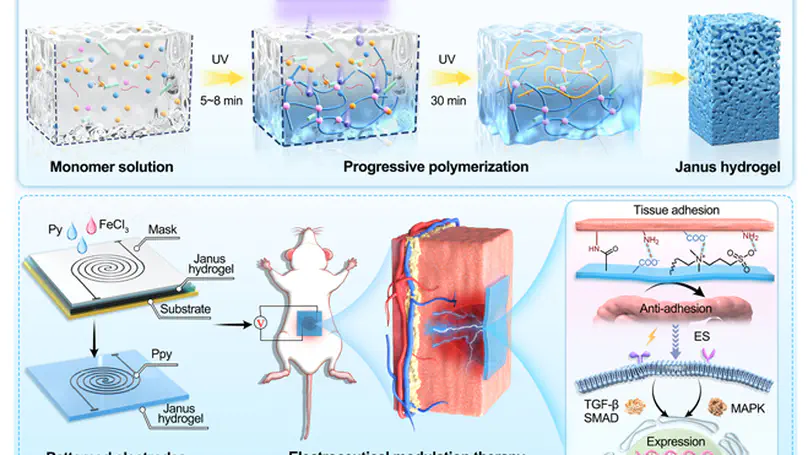
Janus hydrogel bioelectronic interfaces have long been challenged by complex fabrication procedures, poor controllability of asymmetric properties and weak interlayer bonding strength. Herein, we fabricated a Janus hydrogel with dual structural and compositional gradients in one step via Molecular Competition Induction mechanism. Unilateral UV light-driven competitive reactions between distinct monomers induce spatiotemporal progressive polymerization, facilitating heterogeneous distribution of polymer segments and gradient-structure formation. The unique configuration effectively addresses issues of weak interfacial bonding and interlayer slippage in Janus hydrogels. Associated with the programmed directional (upward) migration of adhesive groups during fabrication, the Janus hydrogel achieved a 14.6-fold disparity in interfacial adhesion. After self-assembling patterned polypyrrole conductive percolation network on adhesive side, the Janus hydrogel bioelectronic interface enables robust and efficient bidirectional bioelectrical transduction via mechanical-electrical coupling for electroceutical modulation of abdominal wall injury and electrophysiological signals acquisition. This study provides a facile and universal approach for creating bio-adaptive Janus hydrogel interfaces.

Polymerisation‐Induced Self‐Assembly on Planar Surfaces:A New  Approach for Controlling Surface Topography and Modulating Material‐Bio  Interactions
Polymerisation‐Induced Self‐Assembly on Planar Surfaces:A New Approach for Controlling Surface Topography and Modulating Material‐Bio Interactions

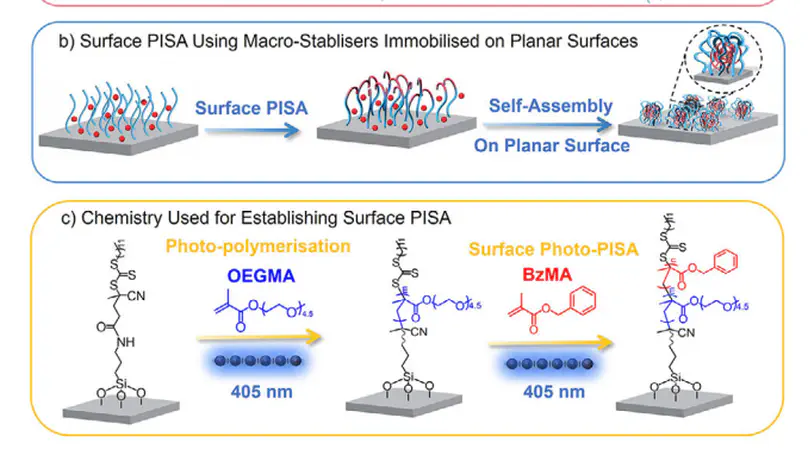
Polymerisation-induced self-assembly (PISA) has emerged as a highly efficient method for synthesising polymeric nanoparticles with diverse and well-defined morphologies for a range of applications. While extensive research has focused on solution-based PISA mediated by conformationally free macro-stabilisers, the process of PISA on planar surfaces using surface-tethered macro-stabilisers with constrained mobility, namely surface PISA, remains largely unexplored. Investigating this process is significant to further advance PISA technology and expand its applications. In this work, we explore surface PISA through both experimental and computational approaches, revealing key differences from conventional solution-based PISA. We also demonstrate that surface PISA offers an innovative approach for controlling surface topography and modulating material-bio interactions. Specifically, we showcase its versatile application in creating slippery liquid-infused porous surfaces (SLIPS) and encapsulating antibiotics, endowing material surfaces with enhanced antifouling and antimicrobial properties. We believe this work is a significant step forward for PISA technology and will create new opportunities for its broader applications.

Insight into the Regulatory Role of Defect Evolution on the Growth of Single-Crystalline Covalent Organic Frameworks

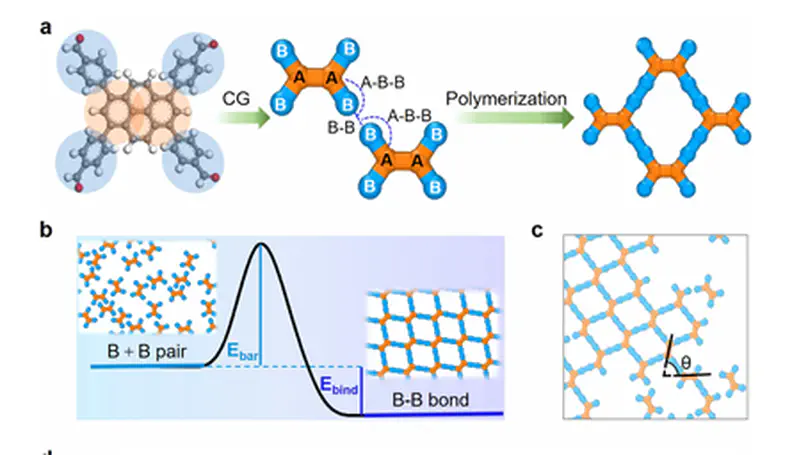
The rapid synthesis of large-sized single-crystalline two-dimensional (2D) covalent organic frameworks (COFs) remains a formidable challenge with current synthetic techniques. A thorough microscopic comprehension of the dynamic processes that govern crystal growth from the perspective of defect formation/repair is imperative. Here, molecular dynamics simulations combined with a dynamic bond model are employed to track the real-time defect evolution in the growth of 2D COFs on surfaces. Our results indicate that defects at grain boundaries, caused by the random orientation of monomers, serve as critical barriers to crystal growth. During the growth process, defects evolve through multiple pathways, involving dynamic reorganization and selfrepair. We demonstrate that the interplay between activation energy and binding energy influences defect repair and, thereby, crystal growth and product morphology. Enhancing both forward and reverse reaction rates, achieved by reducing activation and binding energies within a narrow knife-blade parameter space, facilitates rapid defect repair and promotes single-crystal growth. These findings provide mechanistic insights into defect dynamics and inform the rational design of the reaction conditions for the synthesis of high-quality 2D COFs.