摘要
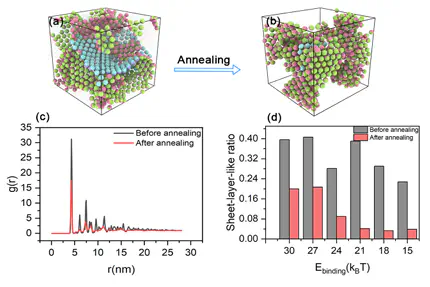
An ideal interfacial microreactor requires a large interfacial area and robust mechanical properties. Bicontinuous emulsion gels, facilitating reactions at the interface of immiscible fluids, are promising candidates, yet their structural stability remains a challenge. A key issue lies in balancing small domain sizes with mechanical strength, hindered by the inherent trade-off between interfacial free-energy reduction and domain-size minimization. Using coarse-grained molecular dynamics, we compared two surfactant systems: in situ-formed nanoparticlepolymer surfactants (NP-PL surfactants) and Janus nanoparticle surfactants (Janus NPs). Our study presents distinct structural evolution pathways and their impact on gel properties. While some Janus NPs may assemble into micelle-like structures that do not contribute to the bicontinuous network, both surfactants enable small domain sizes (∼200 nm), further reducible with increased concentration. Notably, NP-PL surfactants yield gels with superior thermal and kinetic stability, making them more viable for continuous microreactor applications. These findings offer insights for optimizing bicontinuous emulsion gels as effective microreactors.

