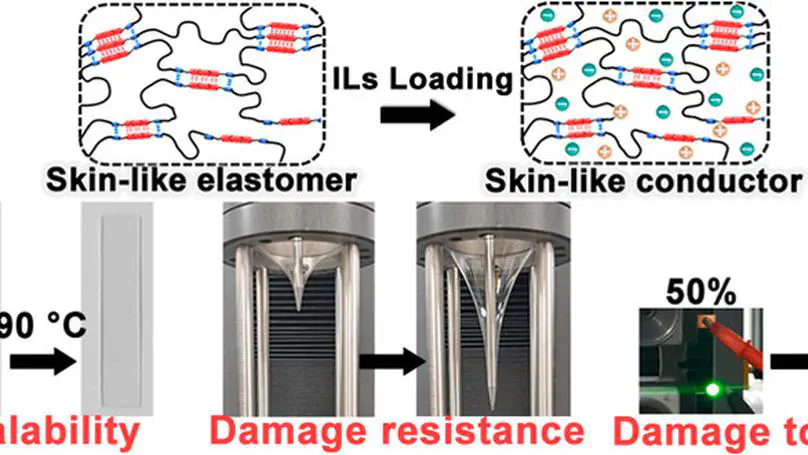
Elastomers play an irreplaceable role in industry and daily life; however, they are usually soft and susceptible to damage. In this study, skin-like poly(urethane-urea) elastomers with high mechanical strength, stretchability, elasticity, and excellent damage resistance, damage tolerance, and healability are fabricated by cross-linking polycaprolactone (PCL) chains with hydrogen-bond arrays. The elastomer, which is denoted as PU-ASC, has a tensile strength of ∼72.6 MPa, recovery strain of ∼500%, and fracture energy of ∼161 kJ m–2. Moreover, the PU-ASC elastomer exhibits unique strain-adaptive stiffening, which endows the elastomer with the capacity to resist damage. The skin-like PU-ASC-IL conductors can be conveniently fabricated by loading ionic liquids (ILs) into the PU-ASC elastomers. The healable, stretchable, elastic, damage-resistant, and damage-tolerant PU-ASC-IL conductors show record-high mechanical performance, with tensile strength, toughness, and fracture energy values of ∼22.8 MPa, ∼164.2 MJ m–3, and ∼73.6 kJ m–2, respectively. The damage resistance and damage tolerance of the elastomers and conductors mainly originate from the disintegrable hydrogen-bond arrays, which are capable of dissipating energy, and the strain-induced crystallization of the PCL segments. Owing to the reversibility of the hydrogen-bond arrays, fractured PU-ASC and PU-ASC-IL can be conveniently healed under heating, restoring their original mechanical performance and conductivity.
Surfaces grafted with polyelectrolyte chains for excellent performance in protein antifouling are highly desired in many applications, such as biomedical implants and devices. In general, the adsorbing/resisting behaviors of proteins can be mainly attributed to the electrostatic interactions that are associated with the charge properties of proteins and polyelectrolytes. By coarse-grained molecular dynamics simulations, we examined the self-assembled structures of polyanion and polyzwitterion brushes as well as the interactions on negatively and positively charged proteins. We found that in addition to charges, the structural polarization induced by self-assembly with a certain charge distribution shows significant influences on protein behavior. The large-scale dipole–dipole interactions between brushes and proteins can dominate the behavior of proteins on the brushes under certain circumstances. To ensure simulation accuracy, we compared two models and found a polar Martini model that explicitly treats electrostatic interactions as long-ranged ones, giving a more reasonable structural description compared with the normal Martini model that truncates electrostatic interactions.
Polymers are widely used in our daily life and industry because of their intrinsic characteristics, such as multi-functionality, low cost, light mass, ease of processability, and excellent chemical stability. Polymers have multiscale space-time properties, which are mainly reflected in the fact that the properties of polymer systems depend not only on chemical structure and molecular properties, but also to a large extent on the aggregation state of molecules, that is, phase structure and condensed state structure. Thanks to the continuous development of simulation methods and the rapid improvement of scientific computation, computer simulation has played an increasingly important role in investigating the structure and properties of polymer systems. Among them, coarse-grained dynamics simulations provide a powerful tool for studying the self-assembly structure and dynamic behavior of polymers, such as glass transition and entanglement dynamics. This review summarizes the coarse-grained models and methods in the dynamic simulations for polymers and their composite systems based on graphics processing unit(GPU) algorithms, and discusses the characteristics, applications, and advantages of different simulation methods. Based on recent studies in our group, the main progress of coarse-grained simulation methods in studying the structure, properties and physical mechanism of polymer materials is reviewed. It is anticipated to provide a reference for further development of coarse-grained simulation methods and software suitable for polymer research.
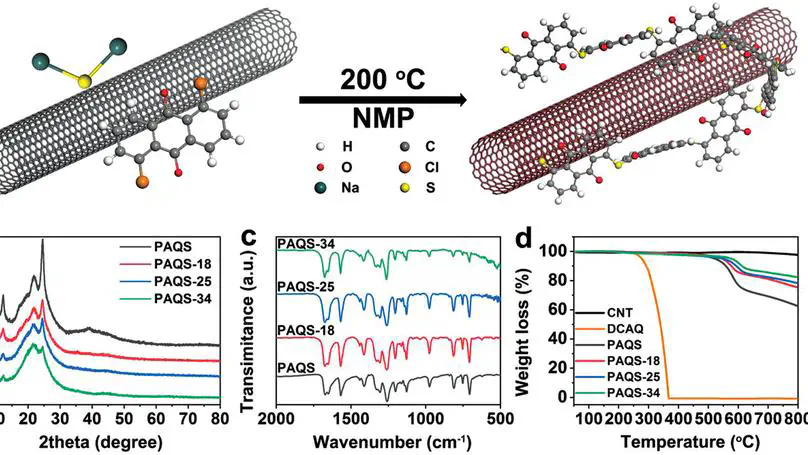
Calcium-ion batteries (CIBs) are considered as promising alternatives in large-scale energy storage due to their divalent electron redox properties, low cost, and high volumetric/gravimetric capacity. However, the high charge density of Ca2+ contributes to strong electrostatic interaction between divalent Ca2+ and hosting lattice, leading to sluggish kinetics and poor rate performance. Here, in situ formed poly(anthraquinonyl sulfide) (PAQS)@CNT composite is reported as nonaqueous calcium-ion battery cathode. The enolization redox chemistry of organics has fast redox kinetics, and the introduction of carbon nanotube (CNT) accelerates electron transportation, which contributes to fast ionic diffusion. As the conductivity of the PAQS is enhanced by the increasing content of CNT, the voltage gap is significantly reduced. The PAQS@CNT electrode exhibits specific capacity (116 mAh g−1 at 0.05 A g−1), high rate capacity (60 mAh g−1 at 4 A g−1), and an initial capacity of 82 mAh g−1 at 1 A g−1 (83% capacity retention after 500 cycles). The electrochemical mechanism is proved to be that the PAQS undergoes reduction reaction of their carbonyl bond during discharge and becomes coordinated by Ca2+ and Ca(TFSI)+ species. Computational simulation also suggests that the construction of Ca2+ and Ca(TFSI)+ co-intercalation in the PAQS is the most reasonable pathway.
Identification and visualization of phase structures inside polymer blends are of critical importance in the understanding of their intrinsic structure and dynamics. However, the direct optical observation of the individual component phase in a dense bulk material poses a significant challenge. Herein, three-dimensional fluorescence imaging of phase separation and real-time visualization of phase transformation in immiscible polymer blends of polypropylene and polystyrene is realized through multiphoton laser scanning microscopy. Owing to the specific fluorescence behavior of the cyanostyrene derivative 2-(4-bromophenyl)-3-(4-(4-(diphenylamino)styryl)phenyl)fumaronitrile, the high-contrast imaging of the macrophase of the component polymer in two and three dimensions with a maximum depth of 140 μm and a high signal-to-noise ratio of 300 can be achieved. Detailed spectroscopic and structural studies reveal that the distinctive fluorescence features of each phase domain should originate from the formation of a completely different aggregate between probes and component polymer. Furthermore, visualizations of the internal morphology deformation and macrophase transformation were realized by employing a stretched dumbbell sample under constant tension.
Using simple achiral building blocks modulated by an external field to achieve chiral liquid crystal phases remains a challenge. In this study, a chiral helix liquid crystal phase is obtained for a simple Gay–Berne ellipsoid model under an alternating external field by using molecular dynamics simulations. Our results show that the chiral helix liquid crystal phase can be observed in a wide range of external field strengths when the oscillation period is smaller than the rotational characteristic diffusion timescale of ellipsoids. In addition, we find that the pitch and tilt angle of the helix structure can also be adjusted by changing the strength and oscillation period of the applied alternating external field. This may provide a feasible route for the regulation of chiral liquid crystal phases by an alternating external field.
Colloidal cubic diamond crystals with low-coordinated and staggered structures could display a wide photonic bandgap at low refractive index contrasts, which makes them extremely valuable for photonic applications. However, self-assembly of cubic diamond crystals using simple colloidal building blocks is still considerably challenging, due to their low packing fraction and mechanical instability. Here we propose a new strategy for constructing colloidal cubic diamond crystals through cooperative self-assembly of surface-anisotropic triblock Janus colloids and isotropic colloidal spheres into superlattices. In self-assembly, cooperativity is achieved by tuning the interaction and particle size ratio of colloidal building blocks. The pyrochlore lattice formed by self-assembly of triblock Janus colloids acts as a soft template to direct the packing of colloidal spheres into cubic diamond lattices. Numerical simulations show that this cooperative self-assembly strategy works well in a large range of particle size ratio of these two species. Moreover, photonic band structure calculations reveal that the resulting cubic diamond lattices exhibit wide and complete photonic bandgaps and the width and frequency of the bandgaps can also be easily adjusted by tuning the particle size ratio. Our work will open up a promising avenue toward photonic bandgap materials by cooperative self-assembly employing surface-anisotropic Janus or patchy colloids as a soft template.
The nanoparticle (NP) surfactants generated in situ by binding NPs and polymers can assemble into an elastic NP monolayer at the interface of two immiscible liquids, structuring the liquids. Janus NPs can be more strongly bound to the interface than the NP surfactants, but they are unable to structure liquids into complex shapes due to the difficulty of assembling the jamming arrays. By molecular dynamics simulations, we give an insight into the better performance of NP surfactants than Janus NPs on dynamically structuring liquids. The high energy binding of Janus NPs to the interface will drive the Janus NPs to assemble into micelles in binary liquids. The micelles are stabilized in one liquid by encapsulating a little of the other liquid, hindering interfacial adsorption when the interface is marginally extended upon liquid deformation. In contrast, the in situ formed NP surfactants can rapidly fill the enlarged interfacial area to arrest the consecutive shape changes of the liquids. Moreover, NP surfactants can be designed with an appropriate coverage ratio (≤50%) of NP surface bearing host–guest sites to avoid dissolution and impart a desirable mechanical elasticity to their assembly.
We have studied the self-assembly of two types of amphiphiles with one or two blocks composed of giant “monomers” of the cubic cage using dissipative particle dynamics (DPD) simulations with the aim to elucidate the influence of the giant monomers on the self-assembly behavior by comparing their self-assembly behaviors with those of conventional AB diblock copolymers. The conformation-symmetric amphiphile with two blocks of giant monomers exhibits a similar transition sequence as that of AB diblock except for the perforated-lamellar morphology replacing the usual double-gyroid morphology. The formation of the PL morphology is attributed to the rigid shape of the cubic monomer as well as the dominant interfacial contribution resulting from the large size of the giant monomer. The other amphiphile with an A block of giant monomers and a B block of conventional monomers has a highly asymmetric conformation due to the large difference in monomer sizes, and thus its phase boundaries are significantly deflected. Moreover, the packing constraint of the rigid cubic A cages leads to the formation of a novel morphology, ill-defined (ID) A-network morphology. In addition, we find that the order–disorder transition temperature is lowered as beads in either A or B block are clustered into the cubic cages. Although the monomer model of the cubic cage is coarsened from the real POSS monomer in the experiments, our simulation results are in qualitative agreement with the experimental results.
Designing complex cluster crystals with a specific function using simple colloidal building blocks remains a challenge in materials science. Herein, we propose a conceptually new design strategy for constructing complex cluster crystals via hierarchical self-assembly of simple soft Janus colloids. A novel and previously unreported colloidal cluster-χ (χc) phase, which resembles the essential structural features of α-manganese but at a larger length scale, is obtained through molecular dynamics simulations. The formation of the χc phase undergoes a remarkable two-step selfassembly process, that is, the self-assembly of clusters with specific size dispersity from Janus colloids, followed by the highly ordered organization of these clusters. More importantly, the dynamic exchange of particles between these clusters plays a critical role in stabilizing the χc phase. Such a conceptual design framework based on intercluster exchange has the potential to effectively construct novel complex cluster crystals by hierarchical self-assembly of colloidal building blocks.