Binders are crucial for maintaining the integrity of an electrode, and there is a growing need for integrating multiple desirable properties into the binder for high-energy batteries, yet significant challenges remain. Here, we successfully synthesized a new binder by cross-linking sodium alginate (SA) with MXene materials (Ti3C2Tx). Besides the improved adhesion and mechanical properties, the integrated SA@Ti3C2Tx binder demonstrates much improved electronic conductivity, which enables ruling out the fluffy conductive additive from the electrode component with enhanced volumetric capacity. When SA@Ti3C2Tx is used to fabricate sulfur (S) cathodes, the conductive-additive-free electrode demonstrates extremely high capacity (1422 mAh cm–3/24.5 mAh cm–2) under an S loading of 17.2 mg cm–2 for Li–S batteries. Impressively, the SA@Ti3C2Tx binder shows remarkable feasibility in other battery systems such as Na–S and LiFePO4 batteries. The proposed strategy of constructing a cross-linking conductive binder opens new possibilities for designing high-mass-loading electrodes with high volumetric capacity.
Wedderburn–Etherington number patterns, which have inherent combinatorial rules, are ubiquitous in natural tree-like systems and are of significance for studying the assembly of single particles into branched superstructures. However, implementing these patterns at the microor nanoscale is still challenging. By controlling the sequential fusion of nanodroplets, these patterns can be reproduced in nanometre-sized branched mesoporous silica structures. Anisotropic mesoporous silica nanoparticles, possessing exposed reaction-active droplet surfaces, are initially synthesized and then assembled following WedderburnEtherington number patterns (1, 1, 1, 2, 3, 6, 11, and so on), forming branched nanotrees containing dimers to multimers. This assembly is achieved by using ligand-grafted palladium nanocrystals as an adhesive, which can fuse the droplets exposed on one side of the preformed nanoparticles. The formed dimers have a Y-shaped architecture with two fused branches (length, ∼395 nm; outer diameter, ∼157 nm) connected by an open tube that grows later, and the sequential fusion-growth style can further extend the Y-structure to multibranched structures. Statistics can predict the degree of branching at each assembly level. The types and configurations of branched structural isomers can also be calculated precisely and are specified by the Wedderburn–Etherington trees.
Assembly of nanoparticles into macroscopic materials with mechanical robustness, green processability, and recastable ability is an important and challenging task in materials science and nanotechnology. As an emerging nanoparticle with superior properties, macroscopic materials assembled from carbon dots will inherit their properties and further offer collective properties; however, macroscopic materials assembled from carbon dots solely remain unexplored. Here we report macroscopic films assembled from carbon dots modified by ureido pyrimidinone. These films show tunable fluorescence inherited from carbon dots. More importantly, these films exhibit collective properties including self-healing, re-castability, and superior mechanical properties, with Young’s modulus over 490 MPa and breaking strength over 30 MPa. The macroscopic films maintain original mechanical properties after several cycles of recasting. Through scratch healing and welding experiments, these films show good self-healing properties under mild conditions. Moreover, the molecular dynamics simulation reveals that the interplay of interparticle and intraparticle hydrogen bonding controls mechanical properties of macroscopic films. Notably, these films are processed into diverse shapes by an eco-friendly hydrosetting method. The methodology and results in this work shed light on the exploration of functional macroscopic materials assembled from nanoparticles and will accelerate innovative developments of nanomaterials in practical applications.
Noncovalently cross-linked polymer materials through healing, recycling, and reprocessing can reduce materials consumption and alleviate environmental pollution. However, it remains a huge challenge to fabricate super-strong noncovalently cross-linked polymer materials with mechanical strength comparable to high-performance engineering polymers. Herein, healable and reprocessable noncovalently cross-linked polymer composites with an unprecedented mechanical strength are fabricated by complexation of polyacrylic acid (PAA), polyvinylpyrrolidone (PVPON), and carbonized polymer dots (CPDs) (denoted as PAA-PVPON-CPDs). The incorporation of 15 wt % CPDs generates PAA-PVPON-CPDs composites with a tensile strength of ∼158 MPa and Young’s modulus of ∼8.2 GPa. Serving as nanofillers, the CPDs can establish strong interactions with polymers in PAA-PVPON composites. The CPDs and the in situ-formed PAAPVPON nanoparticles work in concert to significantly strengthen the PAA-PVPON-CPDs composites to an unprecedented strength. The PAA-PVPON-CPDs composites exhibit excellent impact resistance and damage tolerance because of the high mechanical strength of the composites and the energy dissipation mechanism of the CPDs and PAA-PVPON nanoparticles. Moreover, the fractured PAA-PVPON-CPDs composites can be healed to restore their original mechanical strength.
Confined liquid crystals (LCs) exhibit complex and intriguing structures, which are fascinating fundamental problems in soft matter. The helical structure of cylindrical cavities is of great importance in LC studies, particularly for their application in optical devices. In this study, we employ molecular dynamics simulations to explore the behavior of achiral smectic-B LCs confined in narrow cylindrical cavities, where geometric frustration plays an important role. By increasing the cylinder size, LCs exhibit a transition from multi-helical to layered structures. Notably, we observe two stable structures, namely the helical structure and the layered structure, at moderate cylinder size. We also investigate the effects of the arrangement of cylindrical wall particles (hexagonal or square array) and anchoring strength on the LC structure. Our findings reveal that both the hexagonal array and strong anchoring strength promote the formation of helical structures. Our study provides novel insights into the confinement physics of LCs and highlights the potential for achieving helical structures in achiral LCs, which will expand the future applications of LCs.
Highly conductive and stretchable polymer conductors fabricated from conductive fillers and stretchable polymers are urgently needed in flexible electronics, implants, soft robotics, etc. However, polymer conductors encounter the conductivity-stretchability dilemma, in which high-load fillers needed for high conductivity always result in the stiffness of materials. Herein, we propose a new design of highly conductive and stretchable polymer conductors with low-load nanoparticles (NPs). The design is achieved by the self-assembly of surface-modified NPs to efficiently form robust conductive pathways. We employ computer simulations to elucidate the self-assembly of the NPs in the polymer matrices under equilibrium and tensile states. The conductive pathways retain 100% percolation probability even though the loading of the NPs is lowered to ∼2% volume. When the tensile strain reaches 400%, the percolation probability of the ∼2% NP system is still greater than 25%. The theoretical prediction suggests a way for advancing flexible conductive materials.
Organic materials are promising for cation storage in calcium ion batteries (CIBs). However, the high solubility of organic materials in an electrolyte and low electronic conductivity remain the key challenges for high-performance CIBs. Herein, a nitrogen-rich covalent organic framework with multiple carbonyls (TB-COF) is designed as an aqueous anode to address those obstacles. TB-COF demonstrates a high reversible capacity of 253 mAh g–1 at 1.0 A g–1 and long cycle life (0.01% capacity decay per cycle at 5 A g–1 after 3000 cycles). The redox mechanism of Ca2+/H+ co-intercalated in COF and chelating with C═O and C═N active sites is validated. In addition, a novel C═C active site was identified for Ca2+ ion storage. Both computational and empirical results reveal that per TB-COF repetitive unit, up to nine Ca2+ ions are stored after three staggered intercalation steps, involving three distinct Ca2+ ion storage sites. Finally, the evolution process of radical intermediates further elucidates the C═C reaction mechanism.
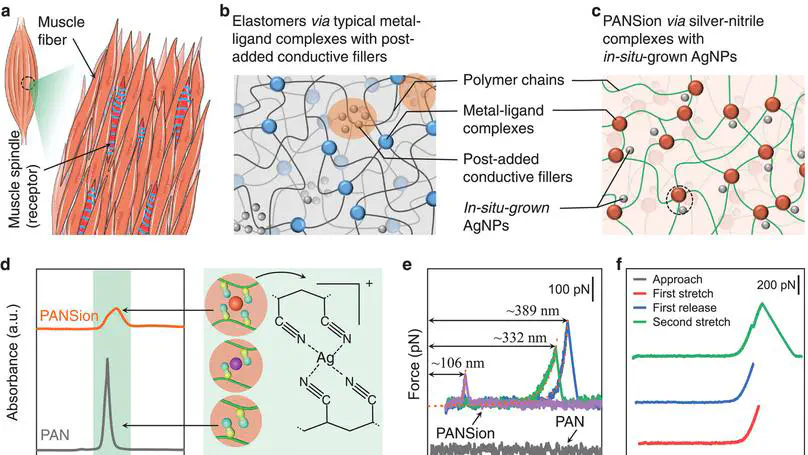
Self-sensing actuators are critical to artificial robots with biomimetic proprio-/exteroception properties of biological neuromuscular systems. Existing add-on approaches, which physically blend heterogeneous sensor/actuator components, fall short of yielding satisfactory solutions, considering their suboptimal interfaces, poor adhesion, and electronic/mechanical property mismatches. Here, a single homogeneous material platform is reported by creating a silver–polymer framework (SPF), thus realizing the seamless sensing–actuation unification. The SPF-enabled elastomer is highly stretchable (1200%), conductive (0.076 S m−1), and strong (0.76 MPa in-strength), where the stretchable polymer matrix synthesis and in situ silver nanoparticles reduction are accomplished simultaneously. Benefiting from the multimodal sensing capability from its architecture itself (mechanical and thermal cues), self-sensing actuation (proprio-deformations and external stimuli perceptions) is achieved for the SPF-based pneumatic actuator, alongside an excellent load-lifting attribute (up to 3700 times its own weight), substantiating its advantage of the unified sensing–actuation feature in a single homogenous material. In view of its human somatosensitive muscular systems imitative functionality, the reported SPF bodes well for use with next-generation functional tissues, including artificial skins, human–machine interfaces, self-sensing robots, and otherwise dynamic materials.
An automatic method is introduced to generate the initial configuration and input file from SMILES for multiscale molecular dynamics (MD) simulation of cross-linked polymer reaction systems. Inputs are a modified version of SMILES of all the components and conditions of coarse-grained (CG) and all-atom (AA) simulations. The overall process comprises the following steps:(1) Modified SMILES inputs of all the components are converted to 3-dimensional coordinates of molecular structures. (2) Molecular structures are mapped to the coarse-grained scale, followed by a CG reaction simulation. (3) CG beads are backmapped to the atomic scale after the CG reaction. (4) An AA productive run is finally performed to analyze volume shrinkage, glass transition, and atomic detail of network structure. The method is applied to two common epoxy resin reactions, that is, the cross-linking process of DGEVA (diglycidyl ether of vanillyl alcohol) and DHAVA (dihydroxyaminopropane of vanillyl alcohol) and that of DGEBA (diglycidyl ether of bisphenol A) and DETA (diethylenetriamine). These components form network structures after the CG cross-linking reaction and are then backmapped to calculate properties in the atomic scale. The result demonstrates that the method can accurately predict volume shrinkage, glass transition, and all-atom structure of cross-linked polymers. The method bridges from SMILES to MD simulation trajectories in an automatic way, which shortens the time of building up cross-linked polymer reaction model and suitable for high-throughput computations.
The design of cellular functions in synthetic systems, inspired by the internal partitioning of living cells, is a constantly growing research field that is paving the way to a large number of new remarkable applications. Several hierarchies of internal compartments like polymersomes, liposomes, and membranes are used to control the transport, release, and chemistry of encapsulated species. However, the experimental characterization and the comprehension of glycolipid mesostructures are far from being fully addressed. Lipid A is indeed a glycolipid and the endotoxic part of Gram-negative bacterial lipopolysaccharide; it is the moiety that is recognized by the eukaryotic receptors giving rise to the modulation of innate immunity. Herein we propose, for the first time, a combined approach based on hybrid Particle-Field (hPF) Molecular Dynamics (MD) simulations and Small Angle X-Ray Scattering (SAXS) experiments to gain a molecular picture of the complex supramolecular structures of lipopolysaccharide (LPS) and lipid A at low hydration levels. The mutual support of data from simulations and experiments allowed the unprecedented discovery of the presence of a nano-compartmentalized phase composed of liposomes of variable size and shape which can be used in synthetic biological applications.